Showing posts with label wool. Show all posts

Why Wool?

Monday, September 25, 2017

Last night the snow came down here in Wyoming. Fortunately, it didn't stay around come morning. The snow, and the chill in the air got me thinking about wool, but, honestly, when am I not thinking about wool?
Why do people use wool for knitting? Why do people have such a negative idea of wool?
To begin this discussion, what is wool? Wool is the protein fiber that grows on sheep. It is shorn or shed from the animal and is then spun into yarn. That's the short of the whole process.
But why do so many people have a bad impression of wool? Maybe they shrank their favorite sweater, maybe it's itchy, maybe they've heard from so many people that it is itchy and they just believe it.
Not all wool is made the same. As we saw from my previous posts about the fiber samples, wool comes in many different colors, lengths, weights, etc.. The best thing to do is to go to a yarn shop and feel all the wool yarns they have; do the neck test. The neck test is when you take a skein or hank of yarn and put it on your neck. The feeling on your neck will tell you a lot. If you find it itchy, there are many reasons why. Wool yarn is made from, for the sake of understanding, the "hair" of the sheep. Fiber is measured in microns. The micron measurement is based on the average diameter of the fiber. Human hair, by comparison, ranges from .017 to .18 millimeters, according to Wikipedia. Wool fibers range any where from less than 21 microns to over 45 microns. The comparison of the two is that 1 micron is .001 of a millimeter. So, fiber diameter is one variable.
Now, you might ask, well what makes wool so variable? It's the same reason why human hair is so different. People from different parts of the world, or with different ethnic backgrounds have vastly different hair. If you look at your own body hair, (this is a lot easier on a hairy, Italian guy) depending on where it grows on the body can yield a very different hair. Pardon the slightly disgusting comparison, but, my sample of Black Welsh Mountain wool (left) was very comparable to pubic hair; that would not make a very comfortable garment. Yet, many of the wool samples I've spun have been like cotton candy. Now who wouldn't like a cotton candy sweater, except maybe a diabetic. Today there are so many new indie dyers and spinners making wonderful yarns from their local wool, you really should see and feel what they have to offer.


The next variable is how the wool was spun. The same sample of wool could be spun worsted and make a very fine thread, think of a fine wool suit, or it could be woolen spun and make a very lofty soft yarn. (left, woolen spun Finn, right worsted spun Finn)

If we look to the psychology behind wool we can see many other reasons why people don't like wool. I believe this to go back to our mothers, and or grandmothers. If we look back to the 1930's and 40's during war time, wool was an important fiber for military uniforms, so it was in scarce commodities to the regular person. What did they do? they recycled old wool. Recycled wool was wool that was taken from yarn, fabric, second cuts, etc., and combed out. This broke the fibers and made it very rough to the touch. Many garments were made from this fabric and some generations lost the feeling of pure new wool, which is where that label came. Pure New Wool, is wool that hasn't been used for anything but this garment. Today recycled wool is sometimes used for rugs and carpeting.

Why should you use wool for your next project? This is a big question. I think the first fear in using wool for a project is it's washing. Yes, wool felts. Wool felts from hot water and agitation. So wash in cool water and by hand. Or if you are lucky and have a fancy new washing machine, wash it on super delicate hand wash cycle. I have done this with cashmere sweaters and they did not felt at all. We also have to let go of the idea that if we wear a garment once it has to be washed. If you don't spill on your sweater you don't have to wash it. I generally only wash my sweaters a few times a year. You definitely want to wash them before going into storage to prevent moths. When drying your sweaters, lay them out on a towel, roll them up into it and squeeze. You'll be amazed how much water comes out. Why should I be worried about shrinking when I can use superwash, or shrink free wool? Some superwash wools are terrible. To make wool superwash there are many things that happen to it. Most of these treatments involve chemicals. Wool fibers are coated with a plastic like coating to prevent the scales on the fibers from locking, these scales are the reason why it felts. Other treatments involve pre-shrinking the wool before it is spun. Do yourself a favor and look it up yourself, you will be surprised how much goes into making shrink proof wool.
This brings up another reason why wool is so wonderful, it's wicking properties. Wool can absorb a lot of water. For example, early firefighters would have wool suits that they would soak in water prior to entering a burning building to prevent it from burning. Wool can also be semi water proof. In the past raw wool was spun in the grease to keep it from absorbing water, seeing as how we know that water and grease do not mix.
Wool can be expensive, but if you are spending upwards of 40 hours of work on a sweater, don't you want it to be the best damn thing you can make? Wool has forgiveness that man made fibers do not have. Blocking can make all the difference in the final project of a wool sweater. These results will most likely not happen in acrylic. Also use your head when thinking about your project. Don't use a luxury fiber, like cashmere, for an out door sweater. Use something that has good body and nice insulation.
I don't think anything is better than a wool sweater, especially one that is hand made with love. It is time you take pride in your knitting. Go out in public and knit and see how many people are fascinated by what you are doing. Take pride in the fact that you are making something with your hands. And never say "oh, I'm just knitting"; most people don't have those motor skills. So, be proud of your skills and their outcomes, and buy some wool for that next project. You can also be very supportive of your local economy by doing so. Most yarn shops have a local section that may include local wool. And last, but not least, do a sheep a favor and use it's wool, it'll have another fleece next year.

In Depth Look at the Fleece Study Part 8

Friday, February 17, 2017

Today marks the fifth in a series of posts in which we are going to look at an in depth explanation of all the breeds in the fleece study. Generally I spun rather thin, but I tried to spin how ever the wool felt comfortable.
Today we are looking at some other fleece samples that do not fit in any of the previous families.


Left to right: Jacob, Columbia, Bleu de Maine, Corriedale


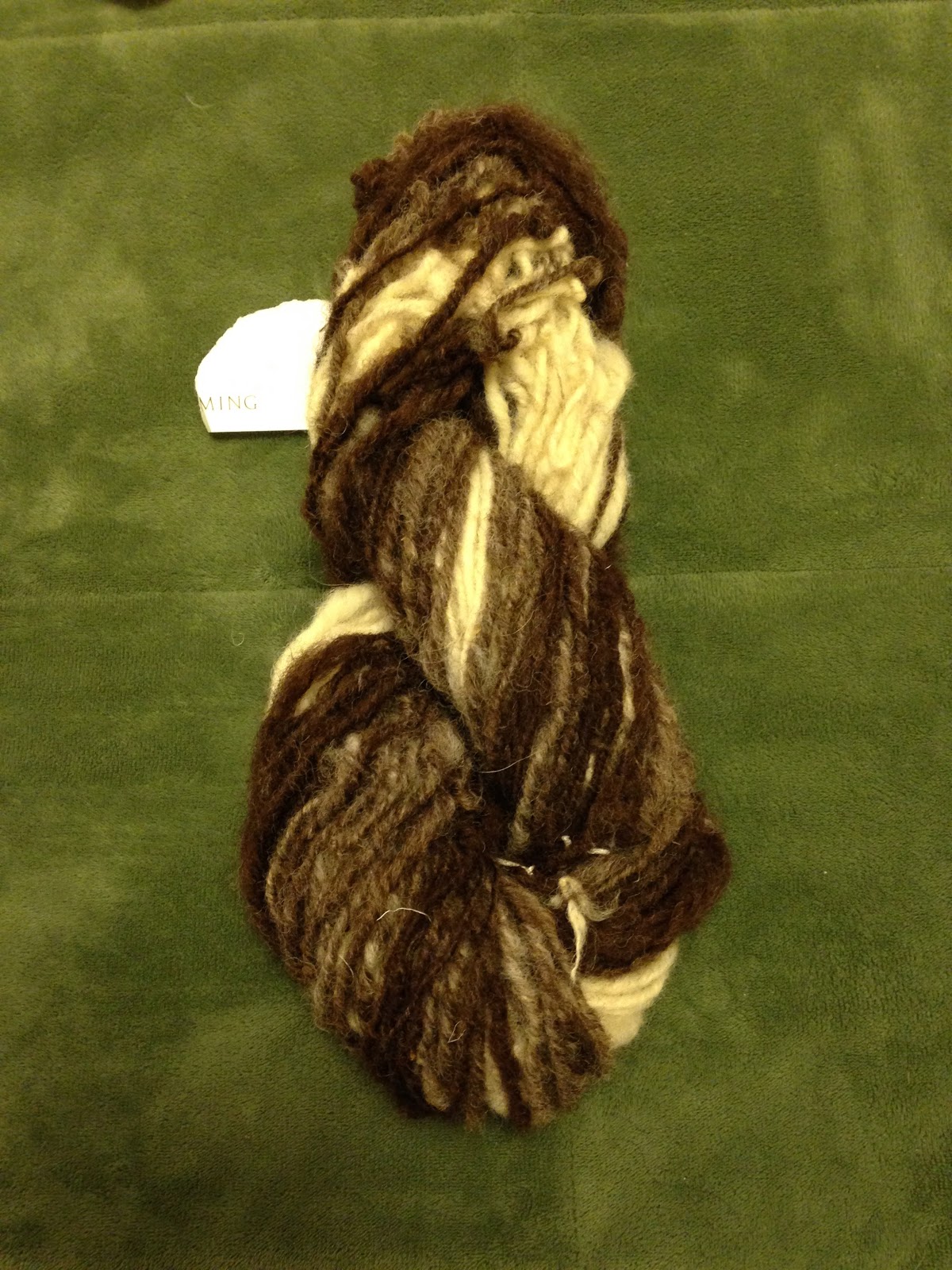
The Jacob sample that I had was a fairly even distribution between brown and white. I split the colors up from brown, to mixed, to white. I then carded the locks into variegated colors and spun them from white, to mixed, to brown. I then took the single and Navajo plied it to keep the color way consistent.


The Columbia sample was carded and spun woolen. The end result is something on the crisp side, but with a nice loft and slight halo.


I was pleasantly surprised with the Bleu de Maine sample. I was able to spin it quite fine from roll logs and still keep a very soft feel. This would be another sample I would spin again.


The last sample to be looked at is Corriedale. I unfortunately spun both the single and the ply in the same directions and it came out a little wonky. However, the sample was easy to card and spin. The resulting yarn, though over plied has a fairly soft hand to it.

Thus concludes the In Depth Look at the Fleece Study. I hope this opened your eyes to many different breeds of sheep and I hope you try some of them. This study was an amazing thing to do as a spinner. It was highly educational and opened many avenues for me to examine the whole process from fiber preparation, to spinning, to setting twist. The next journey in the spinning world for me is going to be a study through the Camelids. Stay tuned!

In Depth Look at the Fleece Study Part 7

Wednesday, February 15, 2017

Today marks the seventh in a series of posts in which we are going to look at an in depth explanation of all the breeds in the fleece study. Generally I spun rather thin, but I tried to spin how ever the wool felt comfortable.
Today we are looking at some other fleece samples that do not fit in any of the previous families.


Left to right: Zwartbles,Texel, Montadale, Ryeland


The Zwartbles sample was one of the most pleasurable samples to spin. It has a very nice chocolate brown color too. The locks were easily carded into nice roll logs perfect for a long draw. I was able to get a very cohesive yarn from it. The finished yarn is nice and soft!


Texel was another surprisingly pleasurable sample. Similar to the Zwartbles, it carded out nicely and is nice and soft with good loft! This is a must try for spinners!


The Montadale sample had a lot of yield to only having roughly 2 ounces. The sample washed out very well and is a crisp white color. This again was carded and woolen spun, nice and soft, I believe it would make a great sweater.


The Ryeland sample is a little more crisp than the rest in this post, but it is still a nice yarn! The finished yarn is lofty. I carded this sample, but I believe if combed or bought as commercial top it would have a great amount of luster to it.

Up next is going to be our last post on the In Depth Look at the Fleece Study!

In Depth Look at the Fleece Study Part 6

Monday, February 13, 2017

Today marks the fifth in a series of posts in which we are going to look at an in depth explanation of all the breeds in the fleece study. Generally I spun rather thin, but I tried to spin how ever the wool felt comfortable.
Today we are looking at some fleece samples that do not fit in any of the previous families.

Right to left: Clun Forest, California Red, Navajo Churro, Karakul


The Clun Forest had a lot of VM in it which made spinning not the most fun. This was carded and spun woolen. It has a soft hand. Parts are fluffy and other parts are quite fine.


The California Red fleece has a nice color that is unlike any other sample in the collection. There are reddish/brown kemp hairs throughout. Again this has a soft hand but with some crispness. This sample was also carded and spun using a woolen technique.


I was excited to spin the Navajo Churro sample. This is a double fleece with long guard hairs, in this sample about 6 inches long, and short wool down, about 2 inches in this. The dual coats separated very easily. The top that came from the combs was rather crisp and scratchy but it has a nice buttery color to it.


The Karakul is another dual coated fleece that I was eager to spin. People might be more familiar with this sheep as Persian lamb, a very common fur trim for vintage coats. This sample was a mixed brown and white wool. The long guard hairs are very coarse, almost horse hair like. This sample was combed and spun from top. It was a little difficult to wield given the length of the fibers. Definitely suitable for rugs.


Coopworth is on the side of being a longwool. This was prepped with the viking combs and spun worsted with a short forward draw. The sample is on the crisp side but would be wonderful for knitted lace. Unfortunately, I think I did not give the ply enough twist when I was spinning so the hank is a little on the loopy side.

In the next post we are going to look at another set of the unclassified family fleeces.

In Depth Look at the Fleece Study Part 5

Saturday, February 11, 2017

Today marks the fifth in a series of posts in which we are going to look at an in depth explanation of all the breeds in the fleece study. Generally I spun rather thin, but I tried to spin how ever the wool felt comfortable.
In this post we will look at breeds from the Feral Family and the Welsh Hill and Mountain Family.


 I only had one sample from the Feral Family, The Gulf Coast Native. This has a very nice color to it in a mottled brown. The sample was carded and spun woolen from roll logs. It has a nice texture to it, perfect for hats. Some fleeces or parts of fleeces may be suitable for next to skin garments; this sample is not one of them. Nor is the next.


This next sample, the only pure natural black sample in the collection is from the Black Welsh Mountain breed from the Welsh Hill and Mountain Family. This fiber sample, when washed and wet looked like something you would pull out of you shower drain if you come from an Italian family. This yarn is single ply. It was spun from roll logs and was spun with a long draw technique. The sample is rather coarse. I did find, in a local shop, locally spun Black Welsh Mountain wool yarn that was not at all like this. It was crisp but had a nice spring and loft to it. This sample was not pleasant to work with but I would try it again.

Up next we are going to begin looking at some of the other breeds that do not fit into the families that I have discussed so far. I wouldn't call them orphans because there are some lovely fleeces in this group that I would quickly adopt.

In Depth Look at the Fleece Study Part 4

Thursday, February 9, 2017

Today marks the fourth in a series of posts in which we are going to look at an in depth explanation of all the breeds in the fleece study. Generally I spun rather thin, but I tried to spin how ever the wool felt comfortable.

In this post we are looking at breeds from the Northern European Short-Tailed Family.


The next family is The Northern European Short-Tailed family. The sheep are from all over the Northern Atlantic Region. This family has some of my other favorites in it. From left to right: Finn (woolen), Finn (worsted), Gotland, Icelandic (seconds, plied), Icelandic (singles, top), Shetland, Soay.


The Finn was a pleasure to spin and is one of the most supple in the whole collection. The woolen has a nice spring to it. This was accomplished by carding the locks into roll logs and then spinning with a low amount of twist in the single. The Finn that was combed on my viking combs was very easy to draft and thus made an evenly spun yarn. Both are quite soft, although I feel like the white is slightly softer than the brown.


Gotland is another longwool. This sample is a nice salt and pepper mix. This sample was combed and spun woolen. The singles are quite fine and the finished skein has a beautiful luster.


Icelandic wool is one of my favorite samples. The two samples are quite different. One is the seconds from the combing process of the top and then plied to itself. The top is pulled from the viking combs and spun in a lopi style single.


This Shetland sample is in the moorit color family. This is not the softest of Shetland samples but it is very nice. I combed this on the viking combs and spun it from top. The finished skein is soft and lofty.


This sample is from an almost undomesticated breed called Soay. The whole process with this sample was unlike any of the others. To begin with the washing, I washed it just like the others, but it was very clumpy. I then took the dry wool to my carders and began carding small batches of it in attempt to get the dander out of the wool. The fleece has a soft undercoat as well as some kemp to it. Traditionally this fiber would have been used in the Faroe and Shetland Islands.

In the next post we are going to look at breeds from the Feral and Welsh Hill and Mountain Family.

In Depth Look at the Fleece Study Part 3

Tuesday, February 7, 2017

Today marks the third in a series of posts in which we are going to look at an in depth explanation of all the breeds in the fleece study. Generally I spun rather thin, but I tried to spin how ever the wool felt comfortable.

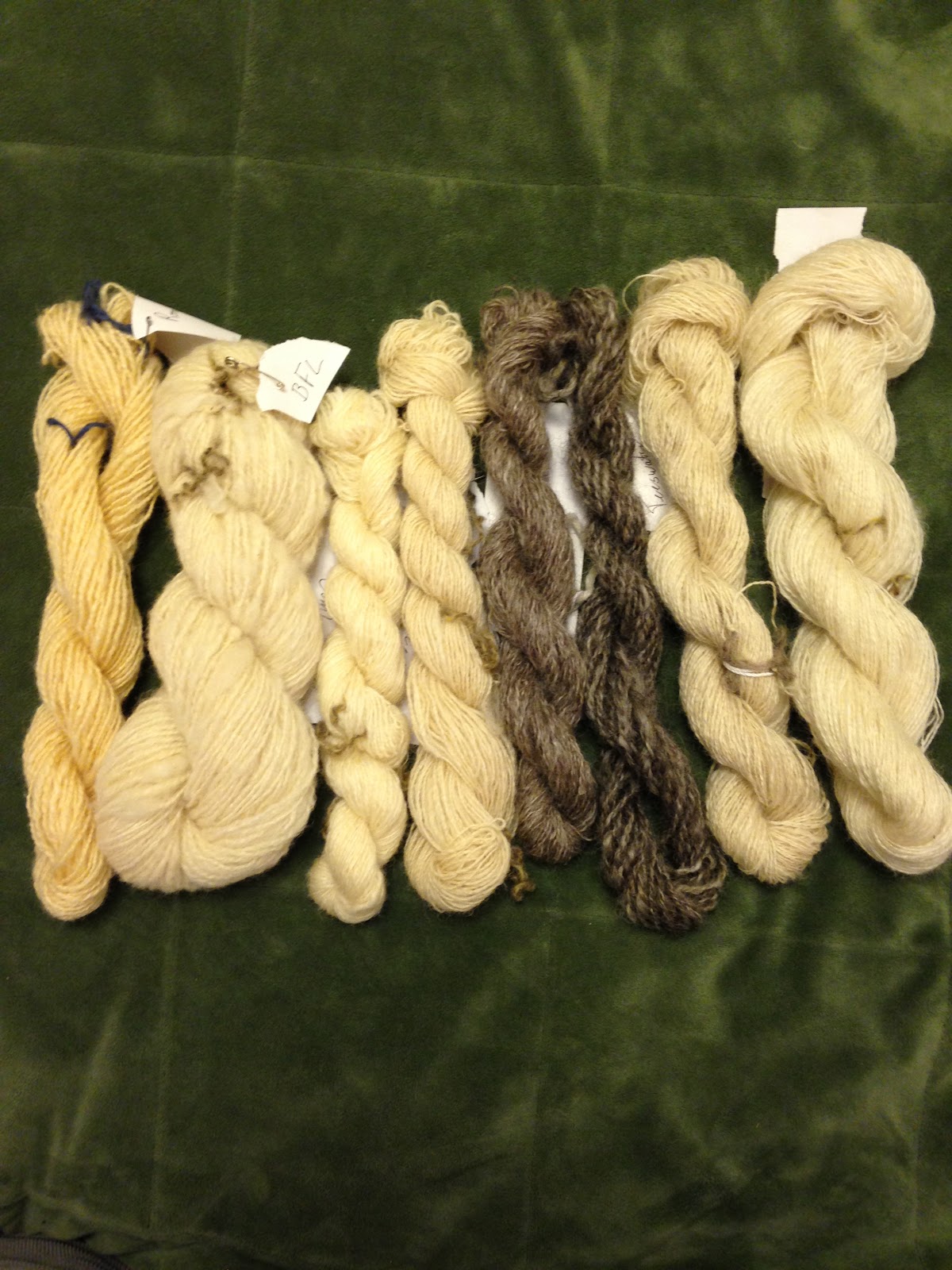
Next we look at my favorite group of wools, The English Longwool Family. These breeds have great luster. I loved spinning each of them. The general longer staple length is not something for a novice spinner, but if you keep in mind that your drafting space needs to be bigger, I'm sure that this is going to be a great success.


Samples from left to right: Romney, Bluefaced Leicester, Border Leicester, English Leicester Longwool, Wensleydale, Lincoln Longwool, Teeswater, and Cotswold.


On the far left is Romney. It has a beautiful buttery color. This was spun from top. It drafted very easily. The locks had nice large crimp patterns.


The next is the Bluefaced Leicester. This was a difficult sample to process. The locks had very tight ringlets. I separated as much out as possible and combed it into top on my viking combs. Pulling it from the combs was fairly difficult due to the spring that the individual fibers had. The top was easy to spin and has a nice loft to it. The end result is very pleasurable.


Next is the Border Leicester. This is a longer lock, more closely resembling the Romney in crimp. It had almost a hair like feel to it. The locks were combed and spun worsted. The finished yarn is quite soft with a nice subtle luster.

The Leicester Longwool, or the English Leicester is the most rough of the three Leicesters. The locks had a similar crimp to them as the Border. Again, I spun this from top keeping a worsted sort forward draft as my spinning technique. It's not my favorite of the group, but I would try it again.


Wensleydale was one of the longer wool samples that I had. It was spun woolen in a short backward draw from hand pulled top. It is a nice charcoal grey color.


Lincoln Longwool was not one of my favorites to prep. It was combed and spun worsted. I believe the dislike was due to poor sheering. There were many second cuts in it. The end skein is soft with a good drape.


These Teeswater locks were quite long and difficult to comb. These locks were combed on my friends' English combs. The locks were about 8 inches long. This made the drafting a little difficult because of how long the staple was. The finished skein has great drape and luster; very similar to mohair.


The last in this family is the sample from a Cotswold sheep. This had a fairly long staple length, about 5-6 inches. The locks were combed and spun worsted. This was another one of my favorites from the set.

In the next post we are going to look at the breeds in the Northern European Short-Tailed Family, home to the Shetland and Icelandic breeds among others!