Showing posts with label handspun. Show all posts

Llamas, and Camels, and Alpacas, Oh My!

Tuesday, May 23, 2017

Camelids are a special kind of mammal, mainly because they have great fiber! There are only a few species in this family, namely camels, then llamas and alpacas, and finally the more endangered Paco-Vicuna and Guanaco.
Alpaca seams to be the most abundant in the fiber world. It is very warm and very soft. It has a beautiful drape and a good staple length. Huacaya Alpaca is a shorter staple length and is most common, from my experience. The Suri Alpaca is much longer, comparable to a longwool, I have not worked with this variety however.
Bactrian Camels, as opposed to the single hump Dromedary Camel, has a decent amount of usable fiber. Both of these breeds are domesticated. Bactrian Camels have a short, cotton like length staple, but it is very soft and considered a luxury fiber.
Llama is a wonderful fiber to spin and knit. It is highly insulating and has a decent drape to it. I have spun to samples of llama, the first one was beautiful with a great staple length and the second, was clumpy and, what I believe, was second cuts. Take it from me, second cuts are not worth it!
Paco-Vicuna is a luxury fiber, it is rather expensive per ounce, but if you can find some, try it, you won't be sorry. It is very similar to camel, but it has a much longer staple length. It would be great blended with other fibers!
Lastly, the Guanaco, is one fiber that I have not been able to get my hand on, but I understand it is wonderful just like the Paco-Vicuna.
Now let's look at some spinning, shall we?
First to examine is baby alpaca. This light grey fiber was a real dream to spin! I spun 8 ounces total, the one on the left is worsted spun and the one on the left is spun semi-woolen, 2-ply. Note the difference in the two. While the worsted spun is spun fine it still has a lot of drape to it.


With the two next to each other, you can really see the difference.

Next, we'll look at the llama. The first sample was bought from a local heard in New York. It was beautiful fiber, very easy to spin, with really wonderful drape. It was spun from roving. The photo doesn't give it justice in terms of color. The fiber is a red brown color with some white thrown in. This was from one llama, I do remember.


The second sample is the not so nice llama.

Note the halo around the ball. You can also see some of the VM that was in the fiber.


This is the single. The lumps are small clumps of short hair, this is why I say it is seconds. There was none of this in the first batch. This was from a different vendor.

This is the plied yarn. Again you can see the lumps and VM throughout the ball. This is a good example as to why you should always take a good look at the fiber you buy. This wasn't expensive, first warning sign, and I was so drawn to the black llama. Very disappointed.

On my spindle below, I have Paco-Vicuna. What a dream it was to spin. This was just a sample of the fiber. It is super soft, with a very fine micron count, and such a warm color.


 In this, I wanted to show how fine it spun. This is next to a regular pencil. I highly recommend this fiber if you can find it!

Finally, we have camel. This is a very short fiber and difficult to spin on it's own. I have had the most success with it spinning on either my quill, or my charka. The fiber is very loft and is that wonderful camel color.
 
   Again, note the size next to a pencil.
This is a camel and silk blend that I recently got at the Interweave Yarn Fest in Loveland, Colorado. It spun up very well!


I hope you enjoyed this quick introduction on the Camel family. Happy spinning!

In Depth Look at the Fleece Study Part 8

Friday, February 17, 2017

Today marks the fifth in a series of posts in which we are going to look at an in depth explanation of all the breeds in the fleece study. Generally I spun rather thin, but I tried to spin how ever the wool felt comfortable.
Today we are looking at some other fleece samples that do not fit in any of the previous families.


Left to right: Jacob, Columbia, Bleu de Maine, Corriedale


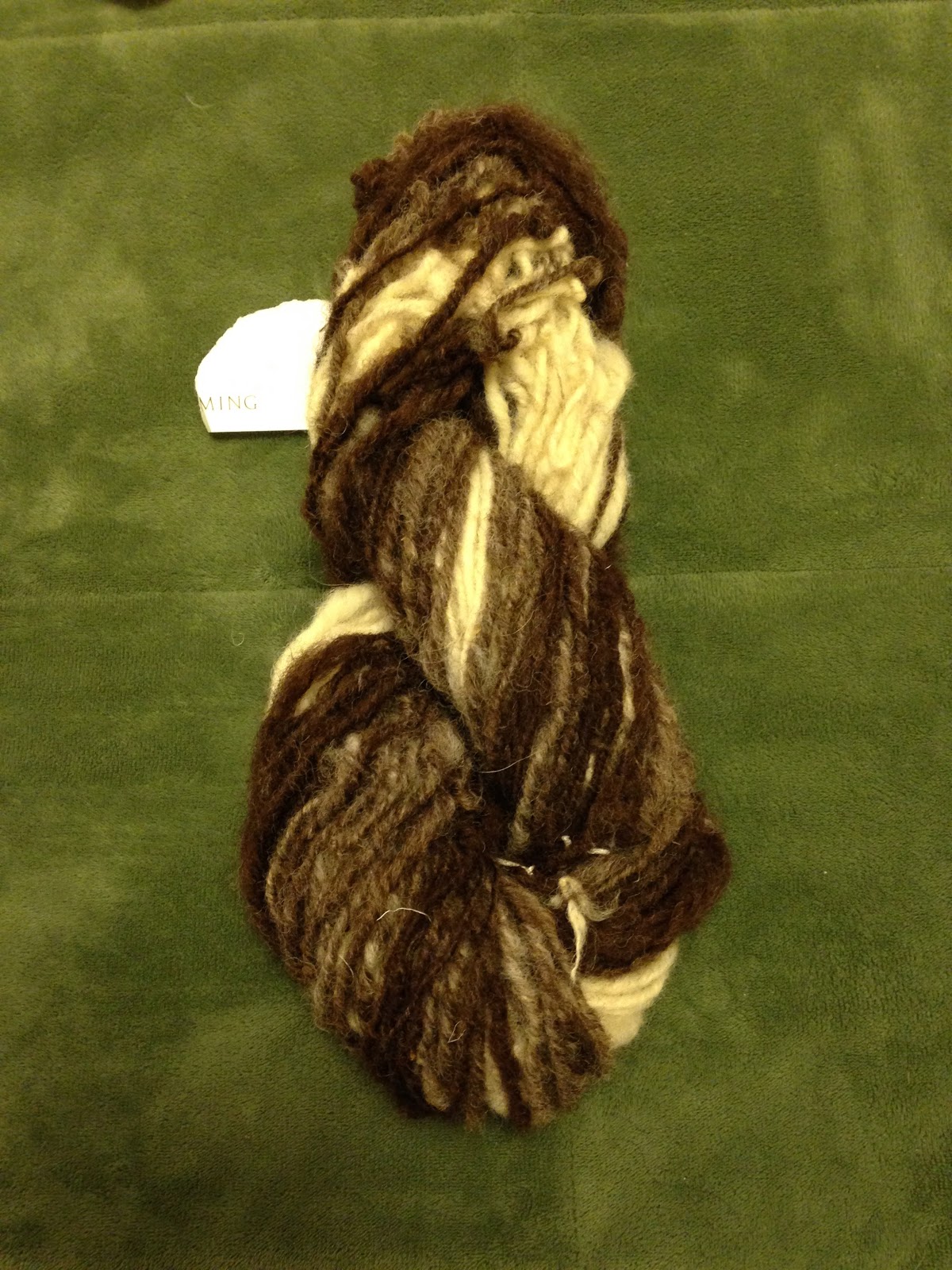
The Jacob sample that I had was a fairly even distribution between brown and white. I split the colors up from brown, to mixed, to white. I then carded the locks into variegated colors and spun them from white, to mixed, to brown. I then took the single and Navajo plied it to keep the color way consistent.


The Columbia sample was carded and spun woolen. The end result is something on the crisp side, but with a nice loft and slight halo.


I was pleasantly surprised with the Bleu de Maine sample. I was able to spin it quite fine from roll logs and still keep a very soft feel. This would be another sample I would spin again.


The last sample to be looked at is Corriedale. I unfortunately spun both the single and the ply in the same directions and it came out a little wonky. However, the sample was easy to card and spin. The resulting yarn, though over plied has a fairly soft hand to it.

Thus concludes the In Depth Look at the Fleece Study. I hope this opened your eyes to many different breeds of sheep and I hope you try some of them. This study was an amazing thing to do as a spinner. It was highly educational and opened many avenues for me to examine the whole process from fiber preparation, to spinning, to setting twist. The next journey in the spinning world for me is going to be a study through the Camelids. Stay tuned!

In Depth Look at the Fleece Study Part 7

Wednesday, February 15, 2017

Today marks the seventh in a series of posts in which we are going to look at an in depth explanation of all the breeds in the fleece study. Generally I spun rather thin, but I tried to spin how ever the wool felt comfortable.
Today we are looking at some other fleece samples that do not fit in any of the previous families.


Left to right: Zwartbles,Texel, Montadale, Ryeland


The Zwartbles sample was one of the most pleasurable samples to spin. It has a very nice chocolate brown color too. The locks were easily carded into nice roll logs perfect for a long draw. I was able to get a very cohesive yarn from it. The finished yarn is nice and soft!


Texel was another surprisingly pleasurable sample. Similar to the Zwartbles, it carded out nicely and is nice and soft with good loft! This is a must try for spinners!


The Montadale sample had a lot of yield to only having roughly 2 ounces. The sample washed out very well and is a crisp white color. This again was carded and woolen spun, nice and soft, I believe it would make a great sweater.


The Ryeland sample is a little more crisp than the rest in this post, but it is still a nice yarn! The finished yarn is lofty. I carded this sample, but I believe if combed or bought as commercial top it would have a great amount of luster to it.

Up next is going to be our last post on the In Depth Look at the Fleece Study!

In Depth Look at the Fleece Study Part 6

Monday, February 13, 2017

Today marks the fifth in a series of posts in which we are going to look at an in depth explanation of all the breeds in the fleece study. Generally I spun rather thin, but I tried to spin how ever the wool felt comfortable.
Today we are looking at some fleece samples that do not fit in any of the previous families.

Right to left: Clun Forest, California Red, Navajo Churro, Karakul


The Clun Forest had a lot of VM in it which made spinning not the most fun. This was carded and spun woolen. It has a soft hand. Parts are fluffy and other parts are quite fine.


The California Red fleece has a nice color that is unlike any other sample in the collection. There are reddish/brown kemp hairs throughout. Again this has a soft hand but with some crispness. This sample was also carded and spun using a woolen technique.


I was excited to spin the Navajo Churro sample. This is a double fleece with long guard hairs, in this sample about 6 inches long, and short wool down, about 2 inches in this. The dual coats separated very easily. The top that came from the combs was rather crisp and scratchy but it has a nice buttery color to it.


The Karakul is another dual coated fleece that I was eager to spin. People might be more familiar with this sheep as Persian lamb, a very common fur trim for vintage coats. This sample was a mixed brown and white wool. The long guard hairs are very coarse, almost horse hair like. This sample was combed and spun from top. It was a little difficult to wield given the length of the fibers. Definitely suitable for rugs.


Coopworth is on the side of being a longwool. This was prepped with the viking combs and spun worsted with a short forward draw. The sample is on the crisp side but would be wonderful for knitted lace. Unfortunately, I think I did not give the ply enough twist when I was spinning so the hank is a little on the loopy side.

In the next post we are going to look at another set of the unclassified family fleeces.

In Depth Look at the Fleece Study Part 5

Saturday, February 11, 2017

Today marks the fifth in a series of posts in which we are going to look at an in depth explanation of all the breeds in the fleece study. Generally I spun rather thin, but I tried to spin how ever the wool felt comfortable.
In this post we will look at breeds from the Feral Family and the Welsh Hill and Mountain Family.


 I only had one sample from the Feral Family, The Gulf Coast Native. This has a very nice color to it in a mottled brown. The sample was carded and spun woolen from roll logs. It has a nice texture to it, perfect for hats. Some fleeces or parts of fleeces may be suitable for next to skin garments; this sample is not one of them. Nor is the next.


This next sample, the only pure natural black sample in the collection is from the Black Welsh Mountain breed from the Welsh Hill and Mountain Family. This fiber sample, when washed and wet looked like something you would pull out of you shower drain if you come from an Italian family. This yarn is single ply. It was spun from roll logs and was spun with a long draw technique. The sample is rather coarse. I did find, in a local shop, locally spun Black Welsh Mountain wool yarn that was not at all like this. It was crisp but had a nice spring and loft to it. This sample was not pleasant to work with but I would try it again.

Up next we are going to begin looking at some of the other breeds that do not fit into the families that I have discussed so far. I wouldn't call them orphans because there are some lovely fleeces in this group that I would quickly adopt.